


What We’re Stress-Testing During Due Diligence (Before We Ever Close a Deal)

By: Laura DeVaney | Co-Founder | Next Legacy Group
February 13, 2026
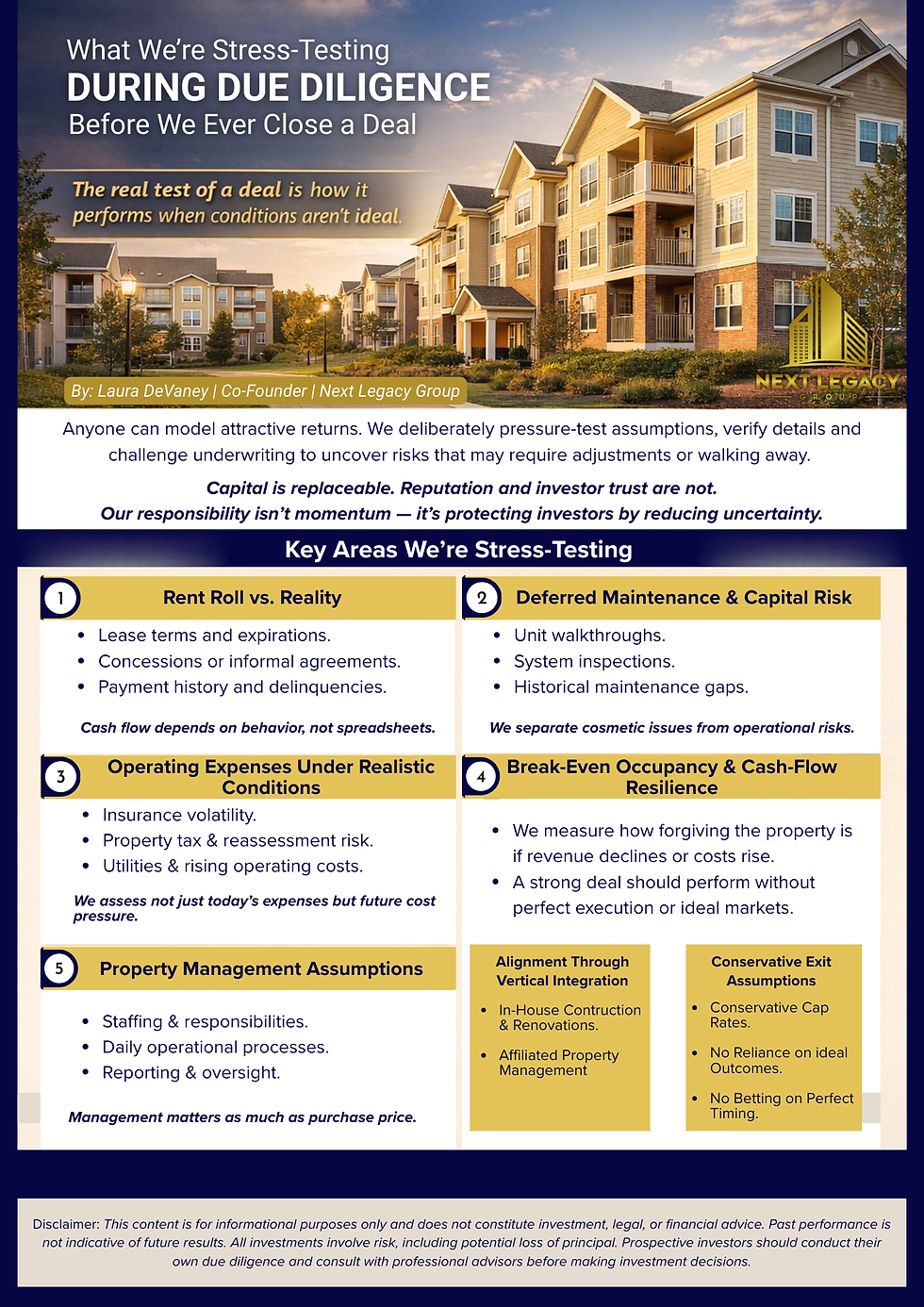
When a property goes under contract, many assume the hard part is over. In reality, that’s when the most important work begins.
At Next Legacy Group, due diligence isn’t a box to check. It’s the phase where a deal is either validated—or disqualified. As we move through due diligence on The Haven, our focus isn’t upside projections or best-case scenarios.
Our focus is simpler:
Identify, resolve or clearly disclose risks early—before closing.
Due Diligence Is About Managing Risk, Not Blind Optimism
Anyone can model strong returns. The real question is how a deal performs when conditions aren’t ideal.
During due diligence, we deliberately pressure-test assumptions and look for areas where reality may differ from underwriting.
That means slowing down, verifying details, and uncovering issues that may require adjustment.
Here are some of the key areas we actively stress-test:
Rent Roll vs. Reality
We don’t just review the rent roll—we verify what income is actually being collected.
This includes:
Lease terms and upcoming expirations
Concessions or informal arrangements
Payment history and delinquencies
Cash flow depends on behavior, not spreadsheets.
Deferred Maintenance and Capital Risk
Not all maintenance issues carry the same level of risk.
We distinguish between:
Cosmetic or deferrable items
Capital issues that impact safety, operations or long-term value
This process includes unit walkthroughs, system inspections and identifying historical maintenance gaps and why they occurred.
Operating Expenses Under Realistic Conditions
Expenses are often where underwriting quietly breaks down.
We closely evaluate:
Insurance assumptions amid ongoing market volatility
Property tax exposure and reassessment risk
Utilities and operating costs that tend to rise over time
We analyze not just today’s expenses but also where cost pressure may build throughout the investment lifecycle.
Break-Even Occupancy & Cash-Flow Resilience
Every deal must answer a simple question:
How forgiving is this property if revenues decline or expenses increase?
We analyze break-even occupancy and overall cash-flow resilience to understand how the property performs without perfect execution or ideal market conditions.
A strong deal should not depend on perfection.
Property Management Assumptions
Execution depends on systems.
We evaluate:
Staffing levels and defined responsibilities
Day-to-day operational processes
Reporting, oversight, and accountability
Management assumptions matter just as much as purchase price.
Alignment Through Vertical Integration
Execution cost and control are critical components of due diligence.
Next Legacy Group operates through a vertically integrated model that includes:
An in-house construction company overseeing renovations
An affiliated property management company operating the asset
For investors, this structure is designed to:
Improve control over renovation scope and timelines
Reduce friction between ownership, construction, and management
Lower operating and renovation costs compared to typical third-party markups
Align incentives directly with property performance
As with every component of due diligence, this model is stress-tested conservatively and documented transparently before closing.
Conservative Exit Assumptions
We underwrite exits with humility.
That means:
Using conservative cap-rate assumptions
Avoiding reliance on multiple expansion
Not depending on perfect timing
If a deal only works under ideal conditions, it’s not a deal we pursue.
Knowing When to Walk Away
Just as important as validation is discipline. There are operational, physical and financial scenarios that would cause us to walk away entirely. That discipline is intentional.
Capital is replaceable. Reputation and investor trust are not.
Our responsibility isn’t to close deals for momentum. It’s to identify risks early, address them honestly, and protect investors by reducing uncertainty wherever possible.
Due diligence isn’t about finding reasons to say yes. It’s about ensuring there are no hidden reasons to say no.
That mindset matters far more than projections and it’s one we apply consistently, long before closing day.


Comments