


How Commercial Real Estate Professionals Are Actually Using AI and How Next Legacy Group Applies It?

By: Jason Ottilo
Co-founder | Next Legacy Group
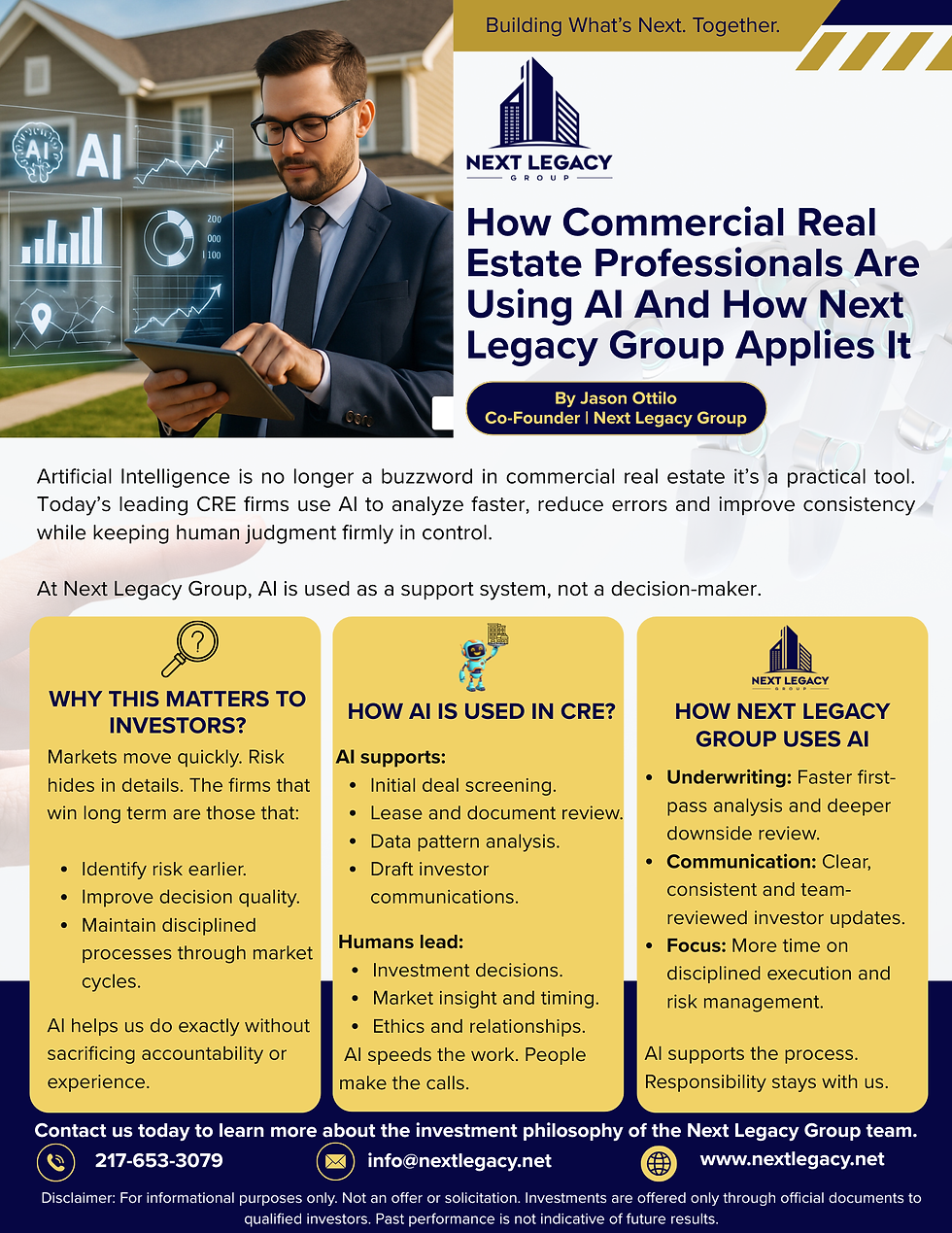
Artificial Intelligence has moved from buzzword to boardroom topic in commercial real estate. Sponsors hear about it from investors. Asset managers see competitors experimenting with it. Analysts quietly use it after hours and don’t always talk about it.
The real question isn’t whether AI is “real.” It’s whether commercial real estate professionals understand what AI actually does, where it creates leverage, and where human judgment remains irreplaceable.
This article breaks that down—without hype, without code, and without pretending AI replaces experience.
What AI Really Is (and Why That Matters in CRE)
At its core, modern AI is not “thinking.” It is large-scale pattern recognition and prediction trained on massive amounts of data. Systems like ChatGPT don’t understand deals the way a sponsor or operator does. Instead, they recognize patterns across millions of documents—leases, offering memorandums, market reports and financial narratives—and predict what a useful response should look like.
That distinction matters because it defines where AI works best.
AI excels at:
Repetitive analytical work
Document review and summarization
Pattern detection across large datasets
Drafting first-pass content
AI struggles with:
Judgment calls and trade-offs
Ethics, nuance, and context
Market timing decisions
Relationship-driven outcomes
In short: AI is a force multiplier, not a decision-maker.
Why This Wave of AI Is Different from the Past
Real estate has seen “AI” before. In prior decades, firms experimented with rule-based underwriting systems and expert systems that promised to automate intelligence. Most failed because they were brittle, expensive, and broke down when markets changed.
Modern AI works differently for three fundamental reasons:
Scale of Training Data – Today’s models are trained on trillions of words, including real estate documents, contracts, market commentary, and financial language.
Transformer Architecture—Modern AI can maintain context across long documents. It can read a 100-page offering memorandum and answer questions that require connecting details across sections.
Transfer Learning—AI doesn’t need to be “trained for real estate” to analyze real estate. It transfers general language understanding into CRE workflows immediately.
That’s why AI is now usable in real-world commercial real estate operations—not as a novelty, but as infrastructure.
Practical CRE Use Cases That Actually Work Today
Here’s where AI is already creating leverage inside real estate firms.
1. Underwriting and Deal Screening
AI works best as a first-pass underwriting assistant:
Reviewing rent rolls for tenant concentration
Flagging lease expirations and rollover risk
Comparing in-place versus market rents
Stress-testing assumptions conceptually
AI does not replace Excel models or investment committee judgment. It reduces analyst time on repetitive review, allowing teams to move faster to high-quality “no’s” and focus more on viable opportunities.
2. Lease and Document Analysis
AI excels at reading unstructured text such as:
Leases
Purchase agreements
Loan documents
Operating agreements
You can ask targeted questions like:
“Where are the tenant termination rights?”
“Summarize rent escalations and expense pass-throughs.”
“Identify unusual landlord obligations.”
This can save dozens of hours per transaction, but every output must be reviewed—AI can sound confident and still be wrong.
3. Investor Communications and Capital Raising
AI is effective for first-draft investor communications:
Investor updates
Deal summaries
Educational content
FAQs
Strong operators use AI to improve consistency and speed, then layer in human judgment, voice, and positioning. Used correctly, this enhances transparency and trust.
4. Custom GPTs for Firm-Specific Workflows
One of the most underutilized tools in CRE is the Custom GPT. A Custom GPT is a configured version of an existing AI model with:
Firm-specific instructions
Uploaded templates and standards
Defined red flags and thresholds
Examples:
An underwriting assistant that always calculates DSCR and debt yield, flagging kill triggers
An investor relations assistant that drafts updates using consistent language and compliance rules
This creates process consistency at scale without increasing headcount or retraining teams repeatedly.
Where AI Fails—and Always Will
AI should never be trusted blindly in commercial real estate. Its limitations include:
It can hallucinate plausible-sounding but incorrect facts
It has no accountability or intuition
It cannot read local market sentiment
It cannot negotiate or assess counterparties
Treat every AI output like work from a sharp intern—useful, fast, and requiring review.
The Strategic Advantage: Focus, Not Automation
The biggest mistake firms make is asking, “How do we automate everything?”
The better question is:
“Where does AI free our best people to focus on judgment, relationships, and execution?”
Winning firms use AI to:
Shorten feedback loops
Reduce low-value labor
Increase consistency
Scale insight without scaling overhead
They are not trying to replace operators, asset managers, or sponsors.
How Next Legacy Group Uses AI — Deliberately
At Next Legacy Group, we don’t use AI to replace judgment, relationships, or experience. We use it to protect them.
Our philosophy is simple: AI should compress time, reduce error, and create space for better decisions—not make decisions for us.
We use AI across three areas:
1. Underwriting Discipline
AI accelerates first-pass analysis—reviewing rent rolls, highlighting lease risk, and stress-testing assumptions—so our team can spend more time pressure-testing downside and validating fundamentals. AI speeds the work; humans own the call.
2. Consistent, Transparent Investor Communication
AI helps structure and draft investor communications, improving clarity and timeliness. Every message is reviewed and refined by our team to ensure accuracy, tone, and alignment with long-term partnership values.
3. Focus on What Compounds Over Time
By reducing time spent on repetitive tasks, AI frees our team to focus on what drives long-term returns: disciplined acquisitions, risk management through cycles, and operational execution.
We do not outsource responsibility to AI. Every output is reviewed. Every decision is owned.
We believe this is how technology should be used in commercial real estate—quietly, carefully and in service of durability. In an environment where speed without discipline destroys value, our objective is the opposite: to move efficiently, think clearly and compound capital responsibly over the long term.


Comments