


Where We Are (and Aren't) Using AI at Next Legacy Group—and Why Credibility Still Wins.
- teresa90643
- 2 days ago
- 4 min read

By: Teresa Loos-Tedrow | Co-Founder | Next Legacy Group
Artificial intelligence is everywhere right now.
Some companies market it as the solution to every business challenge. Others avoid it entirely because of concerns about risk, privacy, or accuracy.
At Next Legacy Group, we believe both approaches miss the point.
The question isn't whether a company uses AI.
The real question is whether AI strengthens trust, improves execution and supports better outcomes—or quietly weakens accountability and judgment.
As a commercial real estate investment company focused on multifamily investing, passive investing opportunities, and long-term wealth creation, we view AI as a tool—not a decision-maker.
Because in our business, credibility remains one of the most valuable assets we have.
It's what earns the first meeting.
It's what creates repeat investors.
It's what helps maintain confidence when markets become uncertain.
And it's what separates sustainable businesses from temporary trends.
Why Credibility Matters More Than Technology
Technology changes rapidly.
Investor trust does not.
Whether you're evaluating a multifamily investment opportunity, building relationships with investors, or managing operations across a growing portfolio, credibility is built through consistency, transparency, and accountability.
No software platform can replace those fundamentals.
That's why we have established clear guidelines around where AI adds value and where human judgment must remain firmly in control.
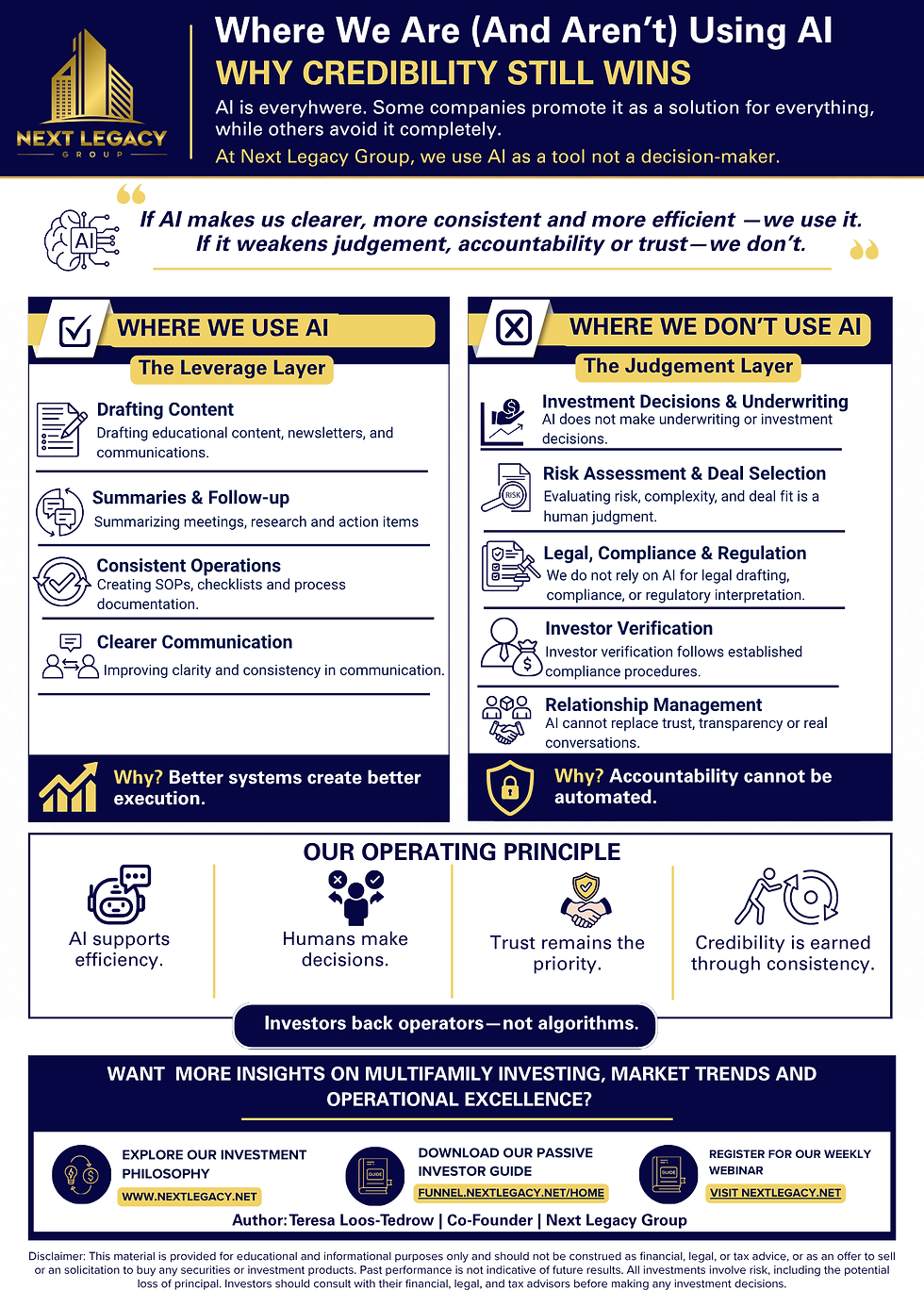
Where We Use AI: The Leverage Layer
1. Drafting Educational Content and Communications
AI helps us move from a blank page to an organized first draft more efficiently.
We use it to assist with:
Educational articles
Investor newsletters
Webinar outlines
Frequently asked questions
Internal communications
However, every piece of content is reviewed, edited, and approved by our team before publication.
Accuracy always comes before speed.
If something sounds persuasive but lacks precision, it doesn't make the final version.
2. Summaries and Follow-Up Actions
One of the most practical applications of AI is helping organize information.
We use AI to summarize:
Meeting notes
Research findings
Market updates
Internal discussions
Action items
This allows our team to focus on execution while reducing the likelihood of missed details.
Strong follow-through builds strong relationships.
3. Operational Systems and Process Documentation
Operational excellence requires repeatable systems.
AI helps us create:
Standard operating procedures (SOPs)
Checklists
Process documentation
Internal workflows
Training resources
Investors don't expect perfection.
They expect consistency.
Documented systems help us deliver that consistency.
4. Communication Clarity and Consistency
Clear communication strengthens investor confidence.
We use AI to support:
Message consistency
Clarity reviews
Formatting improvements
Communication workflows
The goal is simple: communicate more effectively while remaining aligned with our values and investment philosophy.
Where We Don't Use AI: The Judgment Layer
1. Investment Decisions and Underwriting
This is perhaps the most important distinction.
AI can organize information.
AI can identify patterns.
AI can help surface questions.
But AI does not decide whether we invest in a deal.
Investment decisions require evaluating:
Risk exposure
Market conditions
Operational complexity
Business plans
Exit strategies
Portfolio fit
These decisions require experience, judgment, and accountability.
If we outsource judgment, we also outsource responsibility.
That is not a risk we are willing to take.
2. Legal, Compliance and Regulatory Matters
We do not rely on AI to:
Interpret legal requirements
Draft compliance-sensitive language
Provide legal advice
Create regulatory guidance
Compliance exists to protect investors, and that responsibility requires qualified professionals and human oversight.
3. Investor Verification and Suitability
Investor verification follows established regulatory procedures.
This process involves compliance requirements that cannot be delegated to automated systems.
Accuracy and accountability matter too much.
4. Sensitive Investor Information
Protecting investor information is a fundamental responsibility.
Any personal or confidential investor data is treated with the highest level of care.
Trust can take years to build and only moments to lose.
5. Relationship Management
Relationships remain a human responsibility.
AI cannot replace:
Trust
Transparency
Accountability
Difficult conversations
Investor confidence
Investors back operators.
Partners work with people they trust.
Relationships are earned through consistent actions—not generated by software.
The Operating Principle Behind Our AI Strategy
Our philosophy is straightforward:
If AI makes us clearer, more consistent, and more disciplined, we use it.
If AI makes us faster but less accountable, we don't.
We are not trying to become an "AI company."
We are focused on being a durable, principled operating company that leverages the best available tools without surrendering responsibility.
A Better Question for Investors and Operators
As AI continues to evolve, investors should ask more than,
"Are you using AI?"
Instead, ask:
Where are you using it?
Why are you using it?
What safeguards are in place?
Who remains accountable for the outcome?
Those questions reveal far more about a company's culture, discipline and long-term reliability.
Because technology will continue to change.
Markets will continue to change.
But credibility remains one of the few competitive advantages that compounds over time.
And unlike technology, credibility never becomes obsolete.
About Next Legacy Group
Next Legacy Group helps accredited investors build long-term wealth through strategic multifamily real estate investments.
Our mission is to create durable opportunities for passive income, capital preservation, and generational wealth while maintaining a commitment to transparency, operational excellence, and investor trust.
Disclaimer:
This article is provided for educational and informational purposes only and should not be construed as financial, legal, tax, or investment advice, nor as an offer to sell or a solicitation to buy securities. All investments involve risk, including the possible loss of principal. Past performance does not guarantee future results. Investors should consult their financial, legal, and tax advisors before making investment decisions.


Comments